

Consistency in specialty coffee isn't a happy accident of the harvest. It is a calculated result of technical precision and uncompromising logistical oversight. You've likely felt the sting of a core profile that drifts or a shipment that arrived with defects you didn't see coming. To source consistent green coffee in a market where global ending stocks have seen a fifth consecutive annual fall, you need more than just a good palate. You need a system.
We understand that your reputation rests on the integrity of every bag you roast. This guide will help you master the frameworks required to secure high-quality, uniform lots for your roastery. We'll examine how to utilize technical QC standards, the importance of precise sample roasting with the NUCLEUS Link, and how a transparent Wholesale Offer List becomes your most vital asset for predictable inventory management within the UAE's competitive landscape. The journey from origin to warehouse is complex. We're here to help you navigate it with confidence and meticulous care.
Key Takeaways
- Identify the primary causes of flavor drift and learn how to maintain precise organoleptic profiles across multiple harvest cycles.
- Discover the technical frameworks required to source consistent green coffee by balancing the foundational stability of Brazil Green Coffee with seasonal specialty lots.
- Implement rigorous technical verification using the NUCLEUS Link Sample Coffee Roaster (220V) to ensure every shipment meets your roastery's quality standards.
- Utilize a professional Wholesale Offer List to transition toward a proactive inventory framework that prevents stockouts and manages seasonal availability.
- Establish a transparent partnership focused on technical QC and logistical integrity to protect the sensory profile of your year-round offerings.
The Challenge of Consistency in Specialty Green Coffee
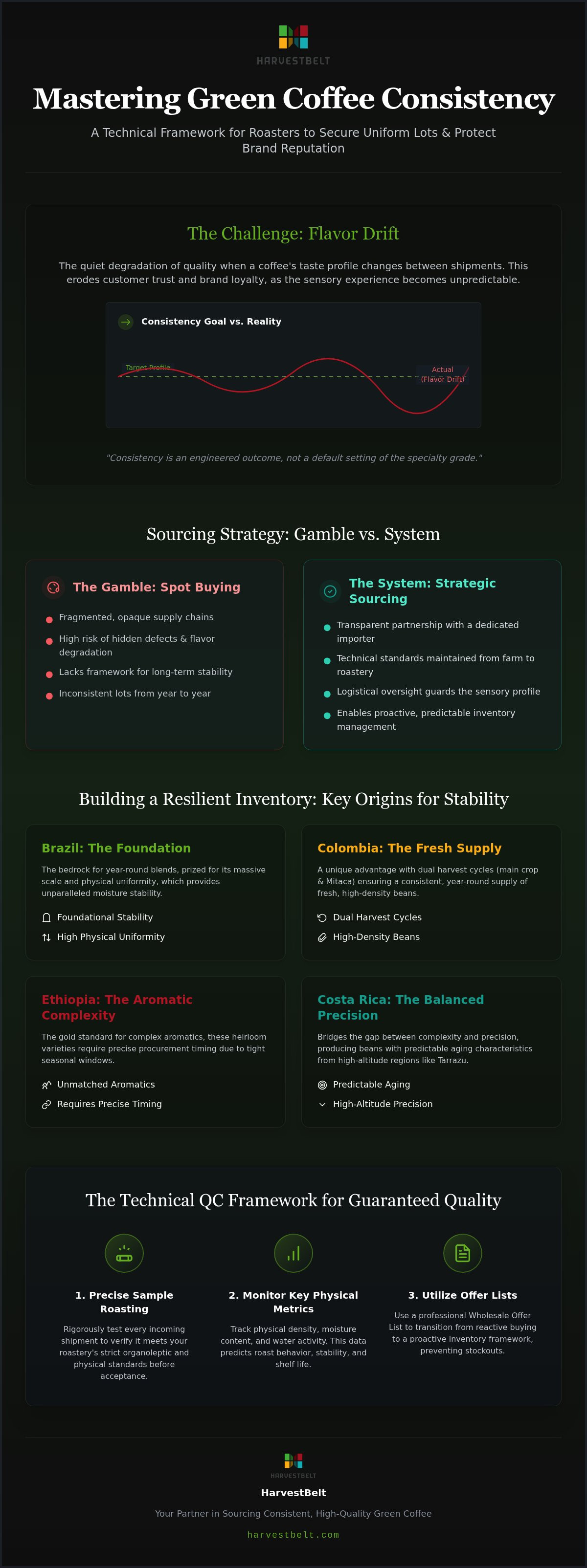
Consistency is the heartbeat of a successful roastery. To source consistent green coffee requires a move beyond the romance of origin toward a cold, technical understanding of agricultural variables. True consistency is defined as the ability to replicate specific organoleptic profiles across multiple harvests and shipments. When a roaster fails here, they encounter flavor drift. This phenomenon occurs when micro-climate shifts or subtle processing variations alter the final cup, even if the lot comes from the same producer. It's a quiet degradation of quality that can go unnoticed until it's too late.
The financial stakes are high. In the UAE's discerning specialty market, a shift in the profile of a flagship blend can erode years of brand loyalty. A customer expects the same sensory experience every morning. If the acidity spikes or the body thins out because of an inconsistent green lot, the trust is broken. While an SCA score of 80+ indicates quality, it is merely a baseline. It doesn't guarantee that the lot will behave like the one before it. Uniformity is an engineered outcome, not a default setting of the specialty grade.
The Variable Nature of the Coffee Belt
The environment is never static. Seasonal shifts in regions producing Brazil Green Coffee or Colombian coffee significantly impact moisture content and water activity. In the high altitudes of Ethiopia, harvest timing dictates the physical density of heirloom varieties, which in turn changes how the bean absorbs heat. Green coffee consistency is the alignment of physical density, moisture, and sensory profile. Without this alignment, your production roasts will never be truly uniform, regardless of your skill at the machine.
Why Traditional Sourcing Often Fails
Relying on spot buying is a gamble. Traditional spot buying makes it nearly impossible to source consistent green coffee year-round because it lacks the logistical framework needed for long-term stability. The global coffee supply chain is often fragmented, leading to flavor degradation during transit as beans pass through multiple hands. When a supply chain is opaque, the roaster bears the risk of hidden defects. A dedicated importer acts as a guardian of the sensory profile, ensuring that the technical standards established at the farm are maintained until the coffee reaches your door.
Evaluating Origins for Profile Stability: Brazil, Colombia, and Beyond
Selecting an origin is more than a sensory choice. It's a logistical strategy. To source consistent green coffee, a roaster must understand which regions offer the stability required for year-round menu planning. While a high-altitude microlot might dazzle on the cupping table, its utility is limited if the profile shifts within months of arrival. Maintaining a reliable supply requires a balance between foundational staples and seasonal highlights.
Brazil Green Coffee serves as the bedrock for many professional roasteries. Its massive production scale and mechanical harvesting methods allow for a level of physical uniformity that is difficult to replicate elsewhere. These lots are prized for their moisture stability, which prevents the development of "baggy" flavors during storage in the UAE's climate. In contrast, Colombian coffee offers a unique advantage through its dual harvest cycles, known as the main crop and the Mitaca. This ensures a fresh supply of high-density beans throughout the year, supported by the mineral-rich volcanic soil that defines its heritage profile.
For those seeking aromatic complexity, Ethiopian coffee from Sidamo or Yirgacheffe remains the gold standard. However, these heirloom varieties are subject to tighter seasonal windows. A roaster must time their procurement perfectly to avoid the quality dip that occurs as the harvest ages. Costa Rica Green Coffee bridges the gap between complexity and precision. High-altitude regions like Tarrazu produce beans with predictable aging characteristics, provided the roaster understands the nuances of their processing.
The Role of Terroir and Altitude
Altitude acts as a natural stabilizer. Beans grown at higher elevations are denser, containing more complex sugars and acids that withstand the stresses of transit. Colombian lots benefit from specific micro-climates that maintain a consistent mineral profile. When you review a Wholesale Offer List, look for lots that emphasize these environmental markers as indicators of long-term stability.
Processing Methods and Uniformity
Processing is where the ability to source consistent green coffee is either won or lost. Washed coffees generally offer more lot-to-lot uniformity because the removal of the mucilage reduces the risk of uncontrolled fermentation. Costa Rican Honey processes, while evocative, require extreme QC rigor to remain consistent across a full shipment. Beyond processing, mechanical sorting by screen size, such as Screen 17/18, is essential. Uniform bean size ensures even heat transfer during the roast, which is the final technical hurdle in delivering a repeatable product to your customers.
The Technical Standard: Sample Roasting and Sensory Calibration
Sample roasting is the final gatekeeper in the specialty supply chain. It acts as the essential bridge between the raw agricultural product and your final production roast. In the UAE, where the specialty scene is rapidly maturing, a dedicated Quality Control (QC) lab is no longer a luxury. It's a fundamental requirement for any roastery that intends to source consistent green coffee. Without a controlled environment for evaluation, you're essentially roasting in the dark, vulnerable to the subtle variations that occur during the long transit from origin to the port of Jebel Ali.
Professional verification requires standardized hardware that removes the guesswork from evaluation. The NUCLEUS Link Sample Coffee Roaster (220V) has emerged as the gold standard for this process. It allows roasters to detect latent defects, such as uneven drying or density inconsistencies, before a single bag reaches the production floor. By identifying these issues early, you protect your production equipment and, more importantly, your brand's sensory promise. Precision in the lab is the only way to ensure that the quality you've paid for is the quality you're actually receiving.
Precision Roasting with the NUCLEUS Link (220V)
Digital profile mapping is the core of modern QC. The 220V version of the NUCLEUS Link is specifically engineered for the electrical standards of the UAE market, ensuring reliable performance in professional lab settings. Unlike traditional sample roasters that rely on manual intuition, this system utilizes density-based roasting profiles. This technical approach ensures that a high-altitude Ethiopian heirloom and a moisture-stable Brazil Green Coffee are each roasted to their specific potential. It provides a transparent, repeatable representation of the bean's true potential, allowing for objective comparisons between different lots.
Sensory Calibration and Cupping Protocols
Technical data must be validated by human expertise. A certified Q-Grader plays a vital role in verifying the sensory claims found on a Wholesale Offer List. This calibration ensures that the perceived acidity, body, and flavor notes align perfectly with your blend requirements. Central to this process is the establishment of a "Golden Sample." The Golden Sample is the sensory benchmark for any recurring blend component, serving as the definitive standard against which all future shipments are measured. This meticulous comparison is the only way to ensure that your year-round offerings remain immune to the drift of the seasons and the volatility of the global market.
Strategic Sourcing: Building a Resilient Inventory Framework
Excellence in roasting is a logistical discipline as much as a sensory one. To source consistent green coffee, you must look beyond immediate availability and build a framework that accounts for the rhythmic fluctuations of the coffee belt. Moving from reactive buying to proactive menu planning allows you to insulate your brand from the volatility of the global market. It's the difference between merely reacting to what is on the water and intentionally securing the future of your flavor profiles.
A resilient inventory relies on a "Core vs. Seasonal" strategy. Your core components, such as high-volume Brazil Green Coffee or Colombian coffee, provide the structural integrity of your blends. These lots require a long-term commitment to ensure they don't vanish during peak demand. Seasonal highlights from Ethiopia or Costa Rica add the aromatic peaks that define your specialty reputation. By understanding the harvest cycles of these origins, you can hedge against seasonal stockouts, ensuring your menu remains vibrant without compromising on the stability of your year-round offerings.
Utilizing the Wholesale Offer List
A professional Wholesale Offer List is your most vital tool for technical planning. It isn't just a price sheet. It's a map of technical data including SCA scores, altitude, and specific varieties. Successful roasters in the UAE plan their procurement three to six months in advance to secure specific lots before they are claimed by the wider market. Forward booking is particularly essential for foundational components. This practice guarantees price stability and lot consistency, allowing you to maintain the exact sensory profile your wholesale partners expect. For a detailed look at upcoming arrivals and technical specs, you can review our current Wholesale Offer List to begin your seasonal planning.
Logistics and Storage in the Middle East
The desert climate of the UAE presents unique challenges for maintaining green coffee freshness. High ambient temperatures and fluctuating humidity can accelerate the aging process, leading to the rapid loss of enzymatic brightness. To source consistent green coffee in this environment, protective packaging is non-negotiable. We prioritize lots arriving in GrainPro or vacuum-sealed liners to create a barrier against the elements. Furthermore, efficient national logistics are critical. Minimizing the time beans spend in non-climate-controlled transit prevents temperature-induced flavor degradation. Once the coffee reaches your roastery, maintaining a stable, cool environment is the final step in protecting the integrity of the harvest until it enters the hopper.
Partnering with HarvestBelt for Reliable Green Coffee Supply
HarvestBelt operates at the intersection of agricultural excellence and technical precision. We serve as a vital bridge between the remote high-altitude farms of the coffee belt and the artisanal roasteries across the United Arab Emirates. To source consistent green coffee is a pursuit of perfection. It requires a partner who understands that the journey of the bean is as critical as its origin. We act as guardians of this journey, ensuring that every lot in our climate-controlled inventory retains the purity and sensory complexity intended by the producer. Our commitment is rooted in integrity, providing a grounded, ethical framework for roasters who share our uncompromising standards.
Our portfolio is intentionally focused. We specialize in specific origins that define the specialty market: the foundational stability of Brazil Green Coffee, the year-round reliability of Colombian coffee, the aromatic brilliance of Ethiopian coffee, and the meticulous processing of Costa Rica Green Coffee. This curated approach allows us to maintain deep technical knowledge of every lot we offer. We don't just provide a list; we provide a verified sensory narrative backed by rigorous quality control standards. Each origin is chosen for its ability to perform consistently under the scrutiny of professional roasting profiles.
A Technical Partnership for UAE Roasters
The advantage of partnering with HarvestBelt lies in our dual expertise. We understand the raw product and the hardware required to master it. By acting as the authorized supplier of the NUCLEUS Link Sample Coffee Roaster (220V), we empower roasters to build their own internal QC frameworks. This hardware is the gold standard for verifying consistency. It ensures that your evaluation process is as sophisticated as the beans themselves. Accessing our latest inventory data is simple. Our Wholesale Offer List provides the transparency you need to navigate the complexities of the global market with quiet confidence. It acts as a live document, reflecting our dedication to commercial clarity and logistical excellence.
Next Steps: Securing Your Supply
Reliability is built on foresight. We encourage roasters to move beyond reactive purchasing and embrace a structured sourcing model. By utilizing our technical data and sample roasting hardware, you can eliminate the hidden defects and flavor drift that threaten your brand's integrity. Whether you're seeking a moisture-stable component for a flagship espresso blend or a vibrant microlot for a seasonal feature, our team is ready to guide your selection. The pursuit of quality is a shared journey. We're here to ensure your roastery has the foundation it needs to thrive in a competitive marketplace.
View the HarvestBelt Wholesale Offer List and secure your next lot
Elevating Your Roastery Standards
Consistency is the hallmark of a master artisan. To source consistent green coffee, you must look beyond the initial cupping and implement a framework of technical verification and strategic planning. We've explored how the stability of high-altitude Brazil and Colombian lots forms the foundation of your menu; meanwhile, precision sample roasting with the NUCLEUS Link (220V) ensures every shipment meets your exacting sensory standards. By transitioning from reactive buying to a proactive model, you protect your brand from the volatility of the global market and the unique challenges of the Middle Eastern climate.
HarvestBelt is committed to being your technical partner in this journey. As an authorized distributor of the NUCLEUS Link (220V) and a curator of specialty-grade SCA 80+ lots from Ethiopia and beyond, we provide the transparency you need to succeed. Our expertise ensures that the integrity of the harvest is maintained from origin to warehouse. Take the next step in securing your inventory and preserving your flavor profiles for the seasons ahead.
Request the HarvestBelt Wholesale Offer List and discover the precision required for a world-class roastery. We're here to help you roast with confidence.
Frequently Asked Questions
What is the most consistent origin for espresso blend bases?
Brazil Green Coffee is the most reliable foundation for espresso blends due to its massive production scale and standardized mechanical harvesting. These factors ensure high physical uniformity across large volumes. The flavor profile is characterized by low acidity and heavy body; it provides a predictable base that anchors more volatile seasonal components. This stability is essential for roasteries that need to maintain a signature house profile throughout the year.
How does the NUCLEUS Link Sample Coffee Roaster (220V) help with sourcing?
To source consistent green coffee, you must verify the physical properties of every incoming lot. The NUCLEUS Link Sample Coffee Roaster (220V) uses density-based profiles to reveal the true potential of a sample. This technical verification allows roasters to detect latent defects or moisture inconsistencies before committing to a bulk purchase. It ensures the cup profile matches the importer's claims, protecting your brand from unexpected flavor drift.
Why should I buy green coffee from a specialized wholesaler instead of a general importer?
Specialized wholesalers provide technical curation and logistical integrity that general importers often lack. They act as a vital bridge between remote producers and local artisans, focusing on specific high-altitude origins. This specialization results in a more transparent supply chain, more accurate sensory data, and a deeper understanding of how specific lots will behave. It's about partnering with a guardian of quality who shares your uncompromising standards.
Can I source SCA 80+ green coffee consistently throughout the year?
Achieving year-round quality is possible through a strategic sourcing framework that accounts for varying harvest cycles. By alternating between the dual harvests of Colombian coffee and the massive annual yield from Brazil, a roastery can maintain an inventory of fresh SCA 80+ lots. Proactive planning using a professional offer list prevents the quality dip often associated with aging harvests. It requires a move from reactive buying to intentional inventory management.
How do I prevent flavor degradation in green coffee stored in the UAE?
Protection against the UAE's desert climate requires a dual approach of environmental control and specialized packaging. Roasters should prioritize lots shipped in GrainPro or vacuum-sealed liners to create a moisture barrier. Once in the roastery, keeping the green coffee in a stable, climate-controlled environment below 25 degrees Celsius is essential. This prevents the rapid loss of enzymatic brightness and protects the bean's aromatic integrity during the hot summer months.
What information should I look for in a Wholesale Offer List?
A professional Wholesale Offer List should provide detailed technical specifications beyond simple flavor notes. Look for SCA scores, precise altitudes, and botanical varieties. Critical data points also include moisture content, water activity, and the exact harvest date. This level of transparency allows you to source consistent green coffee by selecting lots with physical characteristics that align with your existing roasting profiles and production equipment.
Is the NUCLEUS Link (220V) suitable for commercial quality control labs?
The NUCLEUS Link (220V) is specifically engineered for the professional requirements of commercial QC labs. Its digital profile mapping and repeatable precision make it the gold standard for verifying lot uniformity in the national market. It allows for objective, data-driven evaluation, which is vital for maintaining high standards. The 220V version ensures reliable performance within the electrical standards of the UAE's professional roasting facilities.
How do harvest cycles in Colombia and Brazil differ?
Brazil typically follows a single massive harvest cycle from May to August. In contrast, Colombian coffee benefits from two distinct harvest periods: the main crop and the Mitaca. This geographical advantage ensures that fresh green coffee is available to UAE roasters throughout the year. Understanding these rhythmic shifts is key to building a resilient inventory. It allows you to hedge against seasonal stockouts and maintain a vibrant, fresh menu.