

A high SCA score on a spec sheet is no longer a guarantee of excellence. In 2026, it's merely the entry fee for a marketplace that demands absolute transparency and sensory precision. You've likely felt the frustration of a sample that sings in the lab but falters in the production bag. It's difficult to reconcile technical data with the elusive soul of a high-altitude lot, especially when flavor inconsistency threatens your brand's integrity. Your success as a roaster is a direct reflection of your ability to bridge the gap between origin terroir and rigorous quality control.
This green coffee origin guide for roasters provides the definitive framework you need to master the nuances of global harvests. You'll learn how to curate a world-class specialty portfolio that thrives under the new SCA Coffee Value Assessment standards. We'll examine the record 71.9 million bag forecast from Brazil, the evolving traceability requirements, and the technical protocols required to stabilize your QC using 220V lab standards. From the volcanic peaks of Costa Rica to the ancestral forests of Ethiopia, this guide prepares you to secure the most prestigious lots of the season with confidence and precision.
Key Takeaways
- Align your roastery’s brand identity with specific terroir profiles, balancing reliable blend anchors with prestigious single-origin showcases.
- Utilize this green coffee origin guide for roasters to navigate the distinct sensory landscapes of Brazil, Colombia, Ethiopia, and Costa Rica.
- Master technical quality control by integrating the NUCLEUS Link Sample Coffee Roaster (220V) into your laboratory for consistent, high-precision evaluations.
- Secure rare high-altitude lots from niche regions like Guatemala and India by leveraging a curated Wholesale Offer List for seasonal planning.
- Implement a reliable framework for origin comparison that ensures flavor consistency and mitigates the risks of shipment-to-shipment variance.
The Strategic Importance of Origin Selection for Modern Roasteries
Origin selection is the silent architect of a roastery's reputation. It's the first decision that dictates everything from the roast curve to the final cup profile. In a competitive market, your choice of green coffee serves as a mission statement. It signals your commitment to quality, your understanding of terroir, and your ability to navigate the complexities of global trade. This green coffee origin guide for roasters aims to refine that selection process, ensuring every bag contributes to a cohesive brand narrative. Transparency isn't just a buzzword; it's the bridge between the remote producer and the local artisan.
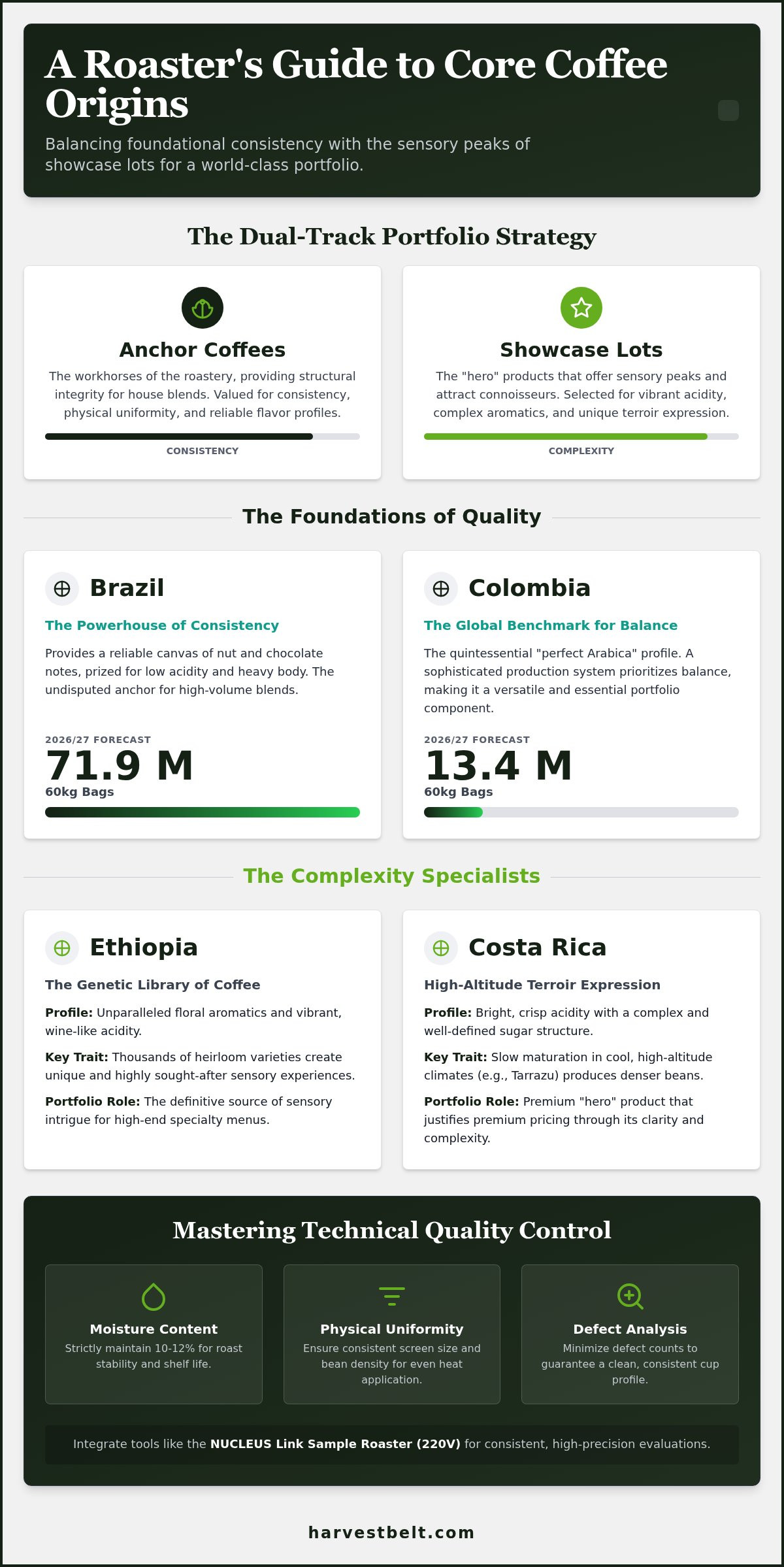
Most successful menus rely on a dual-track strategy. Anchor coffees provide the structural integrity for house blends. They are the workhorses of the roastery. Conversely, showcase lots offer the sensory peaks that attract connoisseurs. Balancing these requires a deep dive into global coffee production statistics to understand which regions can support high-volume consistency versus limited-edition excellence. Without this balance, a roastery risks either sensory monotony or commercial instability.
Consistency vs. Complexity: Finding the Right Balance
Anchor origins, primarily from Brazil and Colombia, offer the chocolate-heavy, nutty profiles that consumers rely on for their daily ritual. These lots are selected for their physical uniformity and stable moisture content. In contrast, showcase lots from Ethiopia or Costa Rica provide the vibrant acidity and floral aromatics that justify premium pricing. These coffees act as the "hero" products of your seasonal rotation. For roasters looking to solidify their supply chain, consulting a Brazil specialty coffee importer UAE can help secure those vital anchor lots with the necessary technical precision.
Environmental Factors: Altitude and Terroir
The physiological development of the coffee cherry is inextricably linked to its environment. High-altitude regions, such as Costa Rica's Tarrazu, subject the plants to cooler temperatures. This slows the maturation process. The result is a denser bean with a more complex sugar structure and bright, crisp acidity. In Guatemala, the mineral-rich volcanic soil imparts a distinct depth and structured body that cannot be replicated elsewhere. Terroir is the holistic intersection of microclimate, soil composition, and topography that dictates the biological potential of a specialty lot. It's a sensory fingerprint of the land itself. Understanding how soil chemistry influences bean density is essential for roasters who want to avoid the pitfalls of inconsistent heat application during the roast.
Decoding the Core Origins: Brazil, Colombia, Ethiopia, and Costa Rica
Every professional portfolio begins with the giants. These four origins represent the architectural pillars of the global specialty industry. This green coffee origin guide for roasters focuses on how these regions maintain their status through a combination of traditional heritage and modern technical standards. While Brazil and Colombia provide the volume and structural balance, Ethiopia and Costa Rica offer the sensory intrigue that defines high-end specialty menus. Understanding these core profiles is the first step in curating a selection that resonates with a discerning UAE audience.
Brazil and Colombia: The Foundations of Quality
Brazil remains the unrivaled powerhouse of consistency. Its 2026/27 production is forecast at a record 71.9 million bags, a testament to its sophisticated agricultural infrastructure. These lots are prized for their low acidity and heavy body, offering a reliable canvas of nut and chocolate notes. In Colombia, the legacy of Jesuit missionaries evolved into a sophisticated production system that prioritizes balance. With a projected 13.4 million bags for the 2026/27 season, Colombian coffee is the global benchmark for the "perfect Arabica" profile. When evaluating these origins, you must look beyond the flavor. Focus on physical metrics such as screen size uniformity, a moisture content strictly between 10% and 12%, and minimal defect counts to ensure your production roasts remain stable.
Ethiopia and Costa Rica: The Complexity Specialists
Ethiopia is the genetic library of the species. It offers thousands of heirloom varieties that produce unparalleled floral and citrus profiles. Navigating Sidamo or Yirgacheffe requires an appreciation for enzymatic complexity and high-altitude density. To ensure the survival of these unique profiles in a changing climate, the research conducted by World Coffee Research is essential for developing resilient cultivars that maintain their ancestral flavor. Costa Rica, though smaller with a 1.2 million bag forecast, exerts a disproportionate influence on processing innovation. It currently ranks 8th globally for quality beans, largely due to its mastery of honey processing. This method bridges the gap between the clarity of a washed coffee and the fruit-forward intensity of a natural, providing the specific complexity your roastery needs to differentiate its seasonal offerings. Before finalizing your seasonal buy, consult our Wholesale Offer List to evaluate the specific SCA scores of our current arrivals.
Exploring Niche Profiles: Guatemala, India, and Indonesia
While the core pillars of the industry provide a roastery’s structural foundation, niche origins offer the sensory "wildcards" that define an avant-garde portfolio. These regions provide the depth required to engage a discerning UAE audience seeking more than just a balanced cup. This green coffee origin guide for roasters highlights how specific microclimates in Guatemala, India, and Indonesia produce profiles that range from volcanic brilliance to deep, earthy complexity. Integrating these origins allows a roaster to curate limited-release lots that act as a signature for their brand identity.
Guatemala and India: Diverse Terroirs
Guatemala’s coffee landscape is defined by its mineral-heavy deposits. The 2026/27 production is forecast at 3.26 million 60-kg bags, with a significant portion originating from the fertile volcanic soils of the Antigua region. These lots are prized for their structured acidity and cocoa-toned finish. In contrast, India is rapidly transcending its reputation for commercial grades. The 2026/27 harvest is projected to reach 6.14 million bags, with high-altitude specialty estates producing Arabica that carries unique spicy and bold notes. These coffees thrive in the shaded polyculture environments of the Western Ghats, offering a sensory profile that is both robust and sophisticated. Sourcing from these diverse terroirs requires a meticulous eye for physical density, as the mineral content in the soil directly influences how these beans absorb heat during the roasting process.
Indonesia: The Specialty Revolution
Indonesia is undergoing a profound transformation in its specialty sector. The "Agents of Change" movement represents a shift toward transparency and meticulous processing standards that were previously rare in the region. A cornerstone of this evolution is the Catur Mena collection, which establishes a quality footprint across six Indonesian provinces. This initiative prioritizes the welfare of the source while ensuring the end-user receives a product of uncompromising integrity. Indonesian specialty lots are characterized by a profound syrupy body and complex earthy undertones, often revealing notes of cedar and tobacco that provide a structural wildcard for adventurous blending.
Evaluating these complex niche profiles demands a modern approach to quality control. As these origins push the boundaries of traditional flavor, roasters must adapt to the new SCA cupping standards to accurately capture their descriptive and affective attributes. Transitioning from the previous protocols to the Coffee Value Assessment ensures that the unique nuances of a high-altitude Guatemalan lot or a processed Indonesian natural are fully realized in the lab before they ever reach the production roaster.
Technical Evaluation: From Sample Roasting to SCA Scoring
Precision is the final gatekeeper. While sourcing the finest lots is essential, the technical validation of those beans separates a world-class roastery from a mediocre one. This green coffee origin guide for roasters emphasizes that sample roasting is the indispensable bridge between raw green inventory and a successful production roast. It's the moment where the theoretical potential of a high-altitude lot is translated into a tangible sensory profile. Without a rigorous, repeatable evaluation protocol, a roaster is navigating the global marketplace without a compass.
The NUCLEUS Link (220V): Precision in the Lab
Professional lab environments in the UAE require equipment that matches the sophistication of the product. The NUCLEUS Link Sample Coffee Roaster (220V) has emerged as a game-changer for specialty buyers. Its design allows for uncompromising control over the roasting environment. This is critical when dealing with diverse densities. A dense, high-altitude Ethiopian heirloom requires a significantly different thermal application than a lower-altitude Brazilian natural. By using the 220V model, roasters ensure technical compatibility and power stability within a professional lab setting. This allows for the calibration of roast profiles that reflect the true biological potential of the origin. It removes the variables of human error and equipment inconsistency. Precision isn't an option; it's a requirement for quality assurance.
SCA Scoring and Sensory Analysis
Objectivity is the foundation of the specialty coffee trade. The SCA cupping form provides a structured framework to evaluate lots scoring 80 and above. Roasters must meticulously analyze fragrance, aroma, acidity, and body to confirm the lot's integrity. This process is about more than just finding pleasant notes. It's about identifying "clean" cups and ensuring the absence of origin-specific defects that could compromise a production batch. A repeatable cupping protocol acts as the final guardian of quality. It ensures that the meticulous care taken during transit from origin is preserved in the final cup. To achieve this level of accuracy, you should enhance your lab precision with the NUCLEUS Link Sample Coffee Roaster. Maintaining this standard protects both your brand's reputation and your financial investment in high-value green coffee. Before committing to your next seasonal purchase, review our technical data and Wholesale Offer List to ensure your inventory meets the highest standards of quality control.
Building a Seasonal Portfolio with a Wholesale Offer List
Curating a world-class coffee menu is a temporal art. It requires a roaster to look beyond the immediate harvest and anticipate the sensory needs of their audience months in advance. A Wholesale Offer List isn't merely a catalog of available inventory; it's a strategic map for long-term growth. This green coffee origin guide for roasters focuses on the transition from technical evaluation to commercial implementation. By aligning your purchasing schedule with global harvest cycles, you ensure that your roastery remains a destination for freshness and variety throughout the year.
Strategic Sourcing and Inventory Management
Effective inventory management relies on a sophisticated seasonal rotation. You must balance the reliable "anchor" lots from Brazil, which provide consistent chocolate and nutty bases, with the vibrant "showcase" arrivals from Ethiopia or Costa Rica. Understanding the timing of "New Crop" arrivals is vital. Freshly harvested lots possess a higher moisture content and more volatile aromatics, requiring subtle adjustments to your roast profiles to capture their peak potential.
- Forecast Demand: Anticipate the high-volume periods in the UAE market to ensure you have sufficient anchor stock.
- Timing the Harvest: Feature Ethiopian lots during their peak freshness to drive premium sales and connoisseur engagement.
- Utilize the Offer List: Use HarvestBelt’s curated data to track upcoming arrivals and secure micro-lots before they reach the general market.
Managing logistics in the UAE presents unique challenges, particularly regarding climate-controlled storage. Freshness must be protected from the warehouse to your roaster. A dedicated supplier acts as a guardian of quality, ensuring that the integrity of high-altitude beans is maintained through every stage of transit. This meticulous care prevents the fading of delicate floral notes and protects your financial investment.
The Final Selection: Quality and Integrity
The final selection of a specialty lot is an act of trust. You're not just buying a commodity; you're becoming part of a high-standard community that values the journey of the product. Integrity in sourcing means choosing partners who prioritize transparency and ethical trade as much as sensory excellence. When you select a lot from a curated list, you're validating the hard work of remote producers and the meticulous technical standards of your laboratory. This commitment to quality is what builds a loyal customer base and establishes your roastery as a leader in the specialty craft. It's time to elevate your inventory with precision and purpose. Browse our curated Specialty Coffee Collection to find your next standout lot and secure the future of your seasonal portfolio.
Elevating Your Roastery's Sensory Legacy
Mastering the specialty market requires a shift from passive buying to active curation. You've seen how the structural reliability of a Brazilian anchor lot complements the vibrant, high-altitude acidity found in Ethiopian or Costa Rican harvests. This green coffee origin guide for roasters provides the framework to navigate these nuances with technical authority. Success in 2026 depends on your ability to validate every lot through precise sample roasting and objective SCA scoring. By prioritizing SCA 80+ specialty grades and utilizing exclusive laboratory hardware, you protect the integrity of your brand from the warehouse to the consumer's cup.
Your journey toward a world-class portfolio is a pursuit of perfection that demands a knowledgeable partner. We act as a guardian of quality, bridging the gap between remote producers and your artisanal craft with meticulous care. It's time to transform your seasonal menu into a narrative of excellence. Secure your next specialty coffee lot from our curated collection and define the future of your roastery. The path to a truly exceptional cup begins with the integrity of the raw bean.
Frequently Asked Questions
What is the difference between single-origin and estate-specific green coffee?
Single-origin is a broad geographic designation; estate-specific coffee originates from one singular farm. This distinction is vital for those using this green coffee origin guide for roasters to build a transparent brand. Estate-specific lots offer a more precise sensory fingerprint. They allow roasters to market the exact microclimate and soil chemistry of a producer. This level of detail resonates with connoisseurs who value the direct connection between the source and the cup.
How much green coffee should a small roastery order to maintain freshness?
Roasters should ideally order inventory that can be consumed within three to six months. Freshness is a fleeting attribute. High-altitude lots begin to lose their vibrant enzymatic activity if stored too long in suboptimal conditions. Maintaining a lean, rotating inventory ensures you always feature "New Crop" arrivals. This strategy prevents flavor degradation and ensures your production remains a showcase of the current harvest’s peak potential and biological integrity.
Why is the NUCLEUS Link Sample Coffee Roaster (220V) better than traditional sample roasters?
The NUCLEUS Link Sample Coffee Roaster (220V) offers unparalleled technical precision compared to traditional, gas-fired sample roasters. It eliminates the variables of thermal lag and environmental humidity. The 220V model is specifically engineered for professional lab environments in the UAE. It provides roasters with repeatable, high-resolution data. This allows for the accurate evaluation of 50g samples, ensuring that expensive specialty lots are never wasted on inconsistent trial roasts.
What does an SCA score of 80+ actually mean for my customers?
An SCA score of 80 or above signifies the official threshold of specialty coffee. For your customers, this score acts as a guarantee of purity and sensory complexity. It means the coffee is free of primary defects and possesses at least one distinctive attribute in acidity, body, or flavor. Serving 80+ lots elevates your roastery’s reputation. It moves the conversation beyond mere caffeine toward a sophisticated, high-end culinary experience.
Can I find high-altitude Costa Rican coffee in the UAE?
High-altitude Costa Rican coffee is readily available in the UAE through specialized distributors like HarvestBelt. We prioritize lots from the Tarrazu and Valle Occidental regions, which are known for their volcanic soil and crisp acidity. These beans are transported with meticulous care and stored in climate-controlled facilities. This ensures that the delicate floral and honey-processed notes remain intact, despite the challenging environmental conditions of the national market.
How does the processing method (Honey vs. Natural) affect my roast profile?
Processing methods fundamentally alter the bean’s sugar structure and density. Natural processing often results in a more porous bean with high surface sugars, requiring a gentler heat application. Honey processing, a staple of our Costa Rica green coffee selection, bridges the gap between washed clarity and natural body. Roasters must adjust their airflow and development time to account for these differences. Mastering these nuances is a core component of any comprehensive green coffee origin guide for roasters.
Is there a minimum order quantity for the Wholesale Offer List?
Minimum order quantities are typically structured around full-bag increments to protect the integrity of the product during transit. Most specialty lots in our Wholesale Offer List are available in 30kg or 60kg units. This standard ensures that the coffee remains in its original protective lining. It also optimizes logistical costs for roasteries operating within the UAE. Buyers should consult the current offer list for specific lot availability and seasonal micro-lot opportunities.
How do I store green coffee to prevent flavor degradation?
Green coffee must be stored in a stable, climate-controlled environment to prevent the loss of moisture and aromatics. Ideal conditions include a temperature between 18 and 22 degrees Celsius with a relative humidity of approximately 60%. Utilizing hermetic liners, such as GrainPro, is essential for protecting the beans from oxygen and ambient odors. Neglecting these standards leads to "faded" profiles. Meticulous storage is the final step in maintaining the guardian of quality persona.